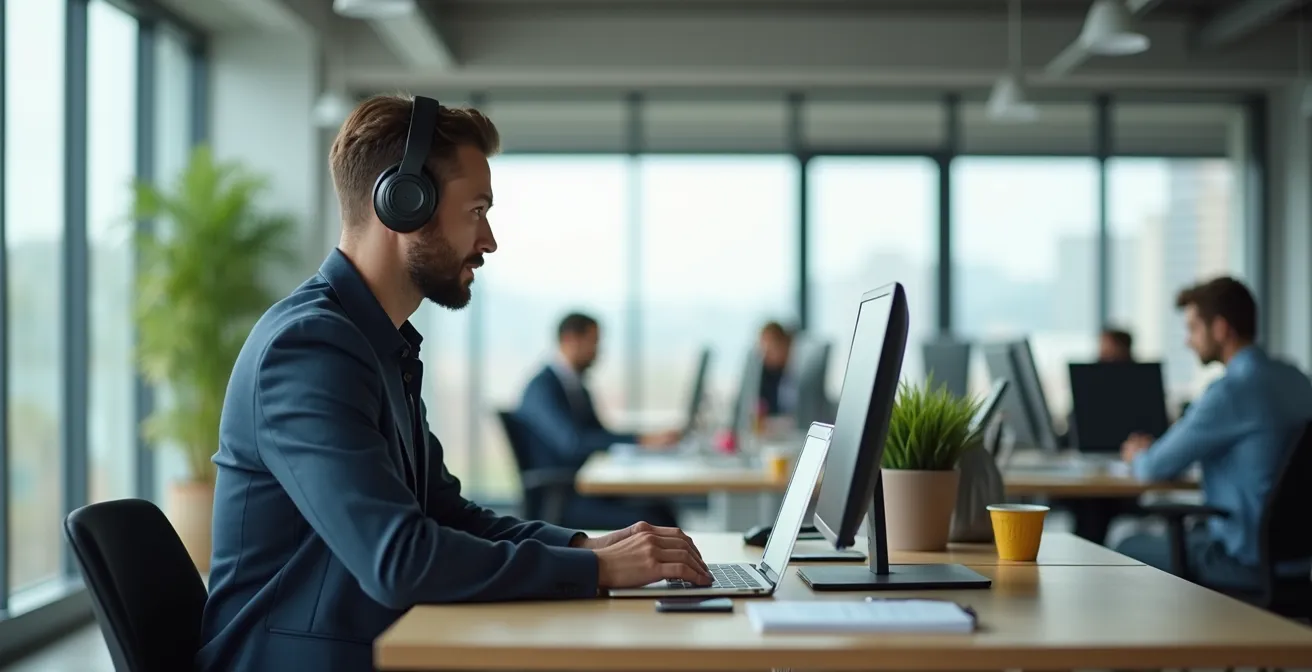
The key to surviving an open office isn’t just blocking noise; it’s actively managing your cognitive load by creating a precisely controlled ‘auditory environment’.
- Active Noise Cancellation (ANC) excels at nullifying the low-frequency hum of HVAC systems, but passive isolation from a good seal is more effective against human speech.
- The ‘pressure’ sensation from strong ANC is a harmless psychoacoustic effect, not a physical change, and can be mitigated with gradual acclimatization.
Recommendation: Create a custom ‘Deep Focus’ profile in your headphone’s companion app by maximizing ANC and adding a low-volume layer of pink or brown noise to mask residual distractions.
That familiar feeling of mental fog rolling in around 2 PM is not just a sign of a long day. In a modern open-plan office, it’s often a symptom of profound cognitive fatigue, driven by a constant, invisible force: ambient noise. Your brain expends a significant amount of energy just to filter out the hum of the air conditioning, the distant chatter, and the clatter of keyboards. The common response is to put on headphones and turn up the music, but this often just replaces one form of cognitive load with another. This approach treats a precision problem with a blunt instrument.
What if the solution wasn’t about drowning out the world, but about surgically sculpting your own pocket of silence? As a workplace wellness consultant and audiologist, I see Active Noise Cancellation (ANC) headphones not as music players, but as clinical-grade tools for managing your personal auditory environment. Their true potential isn’t unlocked by simply flipping a switch, but by understanding the science behind what they can—and cannot—do. It’s about reducing the constant, subconscious effort of filtering sound, thereby freeing up mental resources for deep work and preserving your energy.
This guide moves beyond generic advice. We will explore the specific types of noise that drain your mental battery, differentiate between the technologies designed to fight them, and address the common physical discomforts associated with ANC. More importantly, we will provide actionable strategies to configure your headphones, maintain their performance, and troubleshoot common issues, transforming them from a simple accessory into a cornerstone of your workplace wellness strategy. It’s time to stop fighting noise and start managing focus.
To navigate this comprehensive guide, we will cover everything from the underlying science of noise fatigue to the practicalities of choosing and maintaining the right gear for your specific needs. The following sections are designed to build your expertise, allowing you to create the ideal conditions for concentration.
Summary: Your Guide to Mastering Focus with ANC
- Why the Hum of Air Conditioning Drains Your Mental Energy by 2 PM?
- Passive Isolation or Active Cancellation: Which Is Better for Blocking Human Voices?
- The Discomfort Some Users Feel with Strong ANC and How to Mitigate It
- How to Configure “Silent Mode” on Your Headphones for Pure Focus?
- When to Replace Ear Pads to Restore Lost Noise Cancellation Power?
- Software or Hardware: Which Is Better for Muting Background Baby Cries?
- How to Eliminate Audio Dropouts in Crowded Gyms or Offices?
- Over-Ear or In-Ear: Which Is Less Painful for People Who Wear Thick Glasses?
Why the Hum of Air Conditioning Drains Your Mental Energy by 2 PM?
The constant, low-frequency drone of an office’s heating, ventilation, and air conditioning (HVAC) system is more than a minor annoyance; it’s a primary driver of cognitive load. Unlike a sudden, sharp noise that you consciously notice and dismiss, this persistent hum operates below the threshold of direct attention. Your brain, however, is always working. It subconsciously expends continuous mental energy to process and ignore this sound, a process known as auditory filtering. This steady drain on your neural resources is why you can feel mentally exhausted by mid-afternoon, even without a particularly demanding workload.
This type of sound, typically below 500 Hz, is particularly taxing. The human auditory system is adept at tuning out predictable sounds, but the sheer persistence of the hum forces the brain into a state of low-level, perpetual alert. It’s like running a background application on your computer all day; eventually, it slows down the whole system. The result is a measurable decrease in concentration, a higher susceptibility to distraction from more variable noises like conversations, and a depleted capacity for deep, focused work.
Effectively neutralizing this low-frequency noise is the first and most critical step in creating a productive auditory environment. By removing this foundational layer of sonic “static,” you immediately free up cognitive resources. This doesn’t just make the office “quieter”; it lowers the baseline effort your brain must exert simply to function, leaving more energy for the tasks that actually matter. This is the primary strength of Active Noise Cancellation technology.
Passive Isolation or Active Cancellation: Which Is Better for Blocking Human Voices?
To build an effective auditory environment, you must understand your two primary tools: passive noise isolation and Active Noise Cancellation (ANC). They are not interchangeable and work on fundamentally different principles. Passive isolation is simple physics: it involves creating a physical barrier to block sound waves from reaching your ear. This is achieved through dense materials, like the memory foam in ear pads, that form a tight acoustic seal around your ear. This method is most effective against high-frequency sounds, such as keyboard clicks and the sharp consonants in human speech.
Active Noise Cancellation, conversely, is a sophisticated electronic process. Microphones on the headphones capture incoming ambient sound, and an internal processor generates an inverse sound wave (anti-phase) that is played into your ear. This new wave effectively cancels out the original one, which is why ANC is exceptionally good at eliminating constant, low-frequency sounds like the hum of an engine or an HVAC system. However, it is less effective against sudden, irregular sounds like human speech, as it’s difficult for the processor to predict and counter them in real-time.

So, which is better for voices? The answer is both. A hybrid approach is ideal. ANC will reduce the low-frequency drone that makes voices sound so prominent, while a strong passive seal will muffle the higher-frequency elements of the speech itself. As the following data from a comparative analysis by Belkin shows, neither technology is a perfect solution on its own for the complex frequencies of human speech.
| Noise Type | Frequency Range | ANC Effectiveness | Passive Isolation |
|---|---|---|---|
| HVAC Hum | <500 Hz | Excellent (up to 30 dB) | Poor (5-10 dB) |
| Human Speech | 500-4000 Hz | Moderate (10-15 dB) | Good (15-25 dB) |
| Keyboard Clicks | >4000 Hz | Poor (5 dB) | Excellent (25-35 dB) |
The Discomfort Some Users Feel with Strong ANC and How to Mitigate It
A common complaint from new users of powerful ANC headphones is a sensation of pressure or “eardrum suck,” which can lead to discomfort or even mild nausea. This feeling often causes concern about potential ear damage. However, from an audiological standpoint, it’s crucial to understand that this is a psychoacoustic effect, not a physical one. The sensation is your brain’s interpretation of a sudden absence of low-frequency sound it has become accustomed to processing. It is not caused by an actual change in air pressure on your eardrum. In fact, research confirms there is a 0% physical pressure change on the eardrum when ANC is activated.
Your brain has spent your entire life in an environment filled with ambient, low-frequency noise. When ANC abruptly removes this stimulus, the auditory system can misinterpret this “unnatural” silence. The muscles in your middle ear, particularly the tensor tympani, may react subtly to this new state, creating a feeling of fullness or pressure. It’s an illusion created by the brain as it adapts to a new sensory input, much like getting your “sea legs” on a boat.
The key to overcoming this discomfort is gradual acclimatization, not abandonment. Forcing yourself to wear headphones with maximum ANC all day from the start is a recipe for failure. Instead, a progressive protocol allows your brain to adapt gently. Start by using the ANC feature for short intervals, such as 30 minutes on and 30 minutes off. Over a period of one to two weeks, gradually increase the “on” time while shortening the “off” time. It’s also beneficial to start with a lower ANC setting if your headphones allow it and slowly ramp up to the maximum level. This gentle introduction trains your brain to accept the quiet as the new normal, effectively eliminating the uncomfortable pressure sensation for most users.
How to Configure “Silent Mode” on Your Headphones for Pure Focus?
True focus isn’t just about blocking noise; it’s about creating an intentional state of minimal distraction. Using ANC headphones without any audio playing—a “silent mode”—is a powerful technique, but it can sometimes feel sterile or even highlight the residual high-frequency noises that ANC can’t eliminate. The solution is to move beyond simple silence and actively create a custom ‘Focus Profile’ using your headphone’s companion app. This involves not only maximizing ANC but also adding a masking layer of sound.
This masking layer, often called “soundscaping,” uses a neutral, consistent sound like pink or brown noise played at a very low volume. Unlike music, these sounds have no melody or rhythm, so they don’t demand cognitive resources. Instead, they provide a smooth, unobtrusive sonic “floor” that covers up any remaining distracting noises like distant chatter or keyboard clicks. The key is finding the right volume. Research published in Scientific Reports demonstrates that 45 dB white noise improves focus, while levels around 65 dB can actually increase stress. Your goal is a sound that is barely perceptible, just enough to smooth out the silence.
Configuring a dedicated profile for this state allows for one-touch activation, making it an effortless part of your workflow. By disabling all other features like voice assistants and transparency modes, you create a sanctuary dedicated solely to concentration. This transforms your headphones from a passive device into an active, personalized tool for managing cognitive load.
Your Action Plan: Configure a ‘Deep Focus’ Profile
- Maximize Cancellation: Open your headphone’s companion app and set the Active Noise Cancellation (ANC) to its highest possible level.
- Eliminate Interruptions: Go into the settings and disable all voice assistant features (e.g., “Hey Siri,” “OK Google”) and any touch controls that might be accidentally triggered.
- Ensure Full Isolation: Turn off all transparency, ambient, or “aware” modes. The goal is to block the outside world, not listen to it.
- Add a Masking Layer: If your app has a soundscape feature, select pink or brown noise. If not, use a separate app to play it. Set the volume so it’s barely audible underneath the silence.
- Save and Deploy: Save these settings as a custom profile named ‘Deep Focus’ or ‘Silent Mode’ for instant access when you need to concentrate.
When to Replace Ear Pads to Restore Lost Noise Cancellation Power?
If you’ve noticed your once-powerful ANC headphones seem to be letting in more noise, the problem may not be the electronics, but the ear pads. The effectiveness of any high-end headphone relies on a hybrid system: ANC for low frequencies and passive isolation for high frequencies. This passive isolation is entirely dependent on the integrity of the acoustic seal created by the ear pads. Over time, these pads degrade, compromising the seal and crippling your headphone’s overall performance.
The memory foam inside the pads loses its elasticity, becoming compressed and less able to conform to the shape of your head. The leather or protein-leather covering can develop microscopic cracks or tears. For those who wear glasses, the pads can develop permanent indentations where the arms rest, creating a direct channel for sound to leak in. When this seal is broken, high-frequency sounds like office chatter and keyboard clicks bypass the physical barrier, rendering the passive isolation ineffective. This degradation can be significant; as testing from Headset Advisor reveals, degraded ear pads can reduce ANC effectiveness by up to 40%.
As a rule of thumb, for daily use, you should inspect your ear pads every six months and plan to replace them every 12 to 18 months. Look for these clear signs of wear:
- Visible Damage: Obvious cracks, flaking, or tears in the surface material.
- Compression Failure: When you press on the foam, it doesn’t spring back quickly or feels permanently flattened.
- Reduced Comfort: The headphones feel harder against your head or create pressure points that weren’t there before.
- Audible Performance Drop: You notice a distinct increase in background noise, especially higher-pitched sounds, even with ANC at maximum.
Replacing ear pads is a simple, cost-effective maintenance task that can restore your headphones to their peak noise-cancelling capability, protecting your investment and your focus.
Software or Hardware: Which Is Better for Muting Background Baby Cries?
For remote workers, a crying baby in the background is one of the most challenging and unpredictable sounds to manage, especially during important calls. The high-pitched, variable nature of a cry makes it a difficult target for standard hardware-based ANC. This raises a critical question: is it better to rely on the headphone’s built-in technology (hardware) or a third-party application (software) to suppress it? The answer depends on your primary goal: protecting your own focus or ensuring call clarity for the person on the other end.
Hardware ANC is designed for the user’s benefit. It excels at reducing the low-to-mid frequencies of a cry, making it less jarring for you, but it does little to remove the sound from your microphone’s output. In contrast, AI-powered software solutions like Krisp or NVIDIA RTX Voice work differently. They analyze the audio signal from your microphone in real-time and use machine learning to isolate your voice while aggressively filtering out everything else. This is incredibly effective at ensuring your colleagues hear only you, not the background commotion.
However, an interesting nuance exists with modern headsets, as the Headset Advisor Testing Team noted in their Business Call Testing Report. They found that many devices have a built-in “voice-priority” mode:
When the speaking ceased, so did the sounds of the crying baby. This suggests that both headphones have a microphone that prioritizes voice over noise reduction when speech occurs.
– Headset Advisor Testing Team, Headset Advisor Business Call Testing Report
This means the hardware itself is already performing a software-like function, but it’s only active when you are talking. For a complete solution that protects both your concentration and your professional image on calls, a hybrid approach combining hardware ANC for your ears and software filtering for your microphone is the most robust strategy.
| Solution Type | Primary Benefit | Frequency Range Affected | Use Case |
|---|---|---|---|
| Hardware ANC | User’s focus | 200-2000 Hz fundamental | Personal concentration |
| Software (Krisp/RTX) | Call clarity for others | Full spectrum | Video calls only |
| Passive Isolation | High-frequency blocking | 2000-5000 Hz peaks | Constant protection |
| Hybrid Hardware | Complete solution | Full spectrum | All-day work |
How to Eliminate Audio Dropouts in Crowded Gyms or Offices?
Nothing shatters a state of deep focus faster than your audio stuttering or dropping out completely. This issue is common in “spectrally crowded” environments like a busy office or gym, where dozens of Bluetooth devices and Wi-Fi networks compete for the same 2.4 GHz radio frequency band. While it may seem like a hardware flaw, you can often solve these interference issues with a few strategic software and behavioral adjustments.
The root of the problem often lies with high-bandwidth Bluetooth codecs. Codecs like LDAC and aptX HD are designed to deliver high-fidelity audio, but they require a stable, high-capacity connection. In a congested environment, the connection struggles to keep up, resulting in dropouts. The most effective solution is to force your device to use a more stable, lower-bandwidth codec like SBC or AAC. While technically lower in quality, the difference is often imperceptible for non-critical listening, and the connection stability is dramatically improved.
You can also mitigate interference through physical positioning—a technique called “body shielding.” The human body, being mostly water, is an excellent blocker of 2.4 GHz signals. If your phone is in your back pocket and your headphone’s primary receiver is in the right earcup, your own body can weaken the signal enough to cause dropouts. To avoid this, follow these best practices:
- Switch Your Codec: On Android, enable Developer Options to manually select the SBC or AAC codec. iOS devices use AAC by default, which is generally very stable.
- Mind Your Position: Keep your audio source (phone, laptop) on the same side of your body as your headphone’s primary Bluetooth receiver (usually the right side).
- Reduce RF Competition: If not in use, temporarily disable Wi-Fi on your phone to free up the 2.4 GHz band.
- Use Modern Hardware: Headphones with Bluetooth 5.2 or higher offer better channel-hopping algorithms to navigate interference more intelligently.
By managing both the software protocol and the physical environment, you can ensure a rock-solid connection that protects your auditory sanctuary from technical glitches.
Key Takeaways
- The primary benefit of ANC in an office is reducing cognitive load by eliminating the constant, low-frequency hum of HVAC systems.
- A hybrid approach is essential: ANC targets low frequencies, while passive isolation from a good ear pad seal targets high-frequency speech.
- The uncomfortable “pressure” from ANC is a harmless psychoacoustic effect that can be overcome with gradual acclimatization.
- The ultimate focus tool is a custom ‘Silent Mode’ profile combining max ANC with a low-volume layer of pink noise to mask residual sound.
Over-Ear or In-Ear: Which Is Less Painful for People Who Wear Thick Glasses?
For the millions of office workers who wear glasses, the choice between over-ear and in-ear headphones isn’t just about sound quality—it’s a matter of all-day comfort and performance. The arms of glasses, especially those with thicker frames, can create significant problems for over-ear models. They create a constant pressure point against the side of the head, leading to headaches and discomfort during long work sessions. More importantly from a performance perspective, they break the critical acoustic seal of the ear pads.
When the glasses arms create a gap between the ear pad and your head, it acts as a highway for external sound, particularly the mid-to-high frequencies of human speech, to leak in. This severely compromises the passive noise isolation, forcing you to rely more heavily on the ANC and potentially turn up the volume, further increasing cognitive load. While some over-ear headphones with very soft memory foam and low clamping force, such as the Alienware Pro, can conform around thin glasses arms, the seal is almost always slightly compromised.
For this reason, from a purely clinical and performance standpoint, in-ear ANC earbuds are the superior choice for most people who wear glasses. Because they sit inside the ear canal, there is absolutely no interference from the glasses’ arms. This guarantees a perfect acoustic seal (assuming the correct tip size is used), maximizing passive isolation and allowing the ANC to work at peak efficiency. It eliminates the pressure points and ensures consistent, reliable noise cancellation throughout the workday. The following table from a SoundGuys analysis on workplace headphones illustrates this clear distinction.
| Type | Comfort with Glasses | Seal Integrity | Recommended Features |
|---|---|---|---|
| Over-Ear | Moderate pressure | Often compromised | Memory foam, low clamp force |
| In-Ear ANC | No interference | Perfect seal | Multiple tip sizes |
| On-Ear | Most uncomfortable | Poor with glasses | Not recommended |
By treating your ANC headphones as a clinical tool for managing your auditory environment, you can reclaim your focus and well-being. Start today by assessing your current setup and creating your first ‘Deep Focus’ profile to build a sanctuary for deep work, no matter how chaotic your office is.