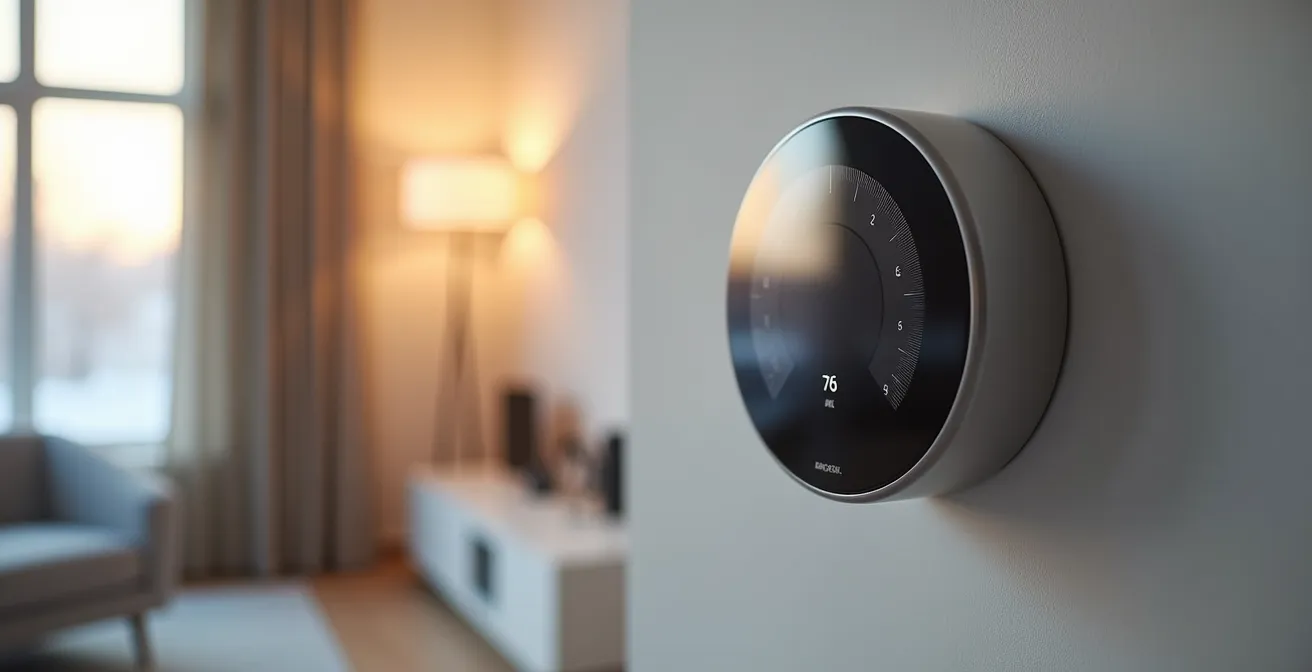
The default “Eco” settings on your smart thermostat are likely costing you money, especially in a home with average insulation.
- Aggressive temperature setbacks force your HVAC system into long, inefficient “recovery runs” that negate any savings.
- Thermostat placement errors and phantom power from other appliances contribute significantly to high bills that scheduling alone can’t fix.
Recommendation: Stop using generic schedules and start performing a simple “Setback Balance Test” to find the unique, energy-efficient sweet spot for your specific home.
You invested in a smart thermostat, meticulously programmed a schedule, and enabled “Eco Mode,” yet the winter heating bill still delivers a painful shock. This is a common frustration for homeowners. The marketing promises automated savings, but the reality is often a system that seems to be working against you. You followed all the conventional advice—turning down the heat when you’re away or asleep—but the needle on your energy costs barely moved. What went wrong?
The issue isn’t the technology itself, but the one-size-fits-all approach to using it. Most guides overlook a critical factor: your home’s unique thermal properties. A schedule that works for a new, perfectly insulated house can be disastrous for an older one. The key to unlocking real savings, potentially hundreds of dollars per season, isn’t just about *when* your heat runs, but understanding *how* your home loses and retains heat and tweaking your system’s logic accordingly.
This guide moves beyond the basics. We’ll dismantle the myths behind “Eco” modes and explore the hidden logic that governs your HVAC system’s efficiency. You’ll learn to diagnose fundamental setup errors, create truly intelligent automations that react to your life, and expand your energy-saving audit to the entire home. It’s time to transform your smart thermostat from a simple timer into a precision instrument tuned for maximum savings.
To help you navigate these advanced strategies, this article breaks down the essential tweaks and concepts. The following summary outlines the key areas we will cover, from optimizing your thermostat’s core logic to securing your entire smart home ecosystem.
Summary: Advanced Smart Thermostat & Home Energy Tweaks
- Why Default “Eco Modes” Can Sometimes Increase Your Bill in Poorly Insulated Homes?
- How to Create an Automation That Turns Off AC When a Window Is Opened?
- The Location Mistake That Causes Your Smart Thermostat to Overheat Your House
- How to Identify Which Appliance Is Costing You $50/Month in Standby Power?
- How to Program Your EV Charger to Run Only When Rates Are Lowest?
- Why Modern Switching Power Supplies Draw Almost Zero Power When Idle?
- How to Create “Invisible” Smart Routines That Work Without Voice Commands?
- How to Create a Dedicated IoT Network to Protect Your Personal Data?
Why Default “Eco Modes” Can Sometimes Increase Your Bill in Poorly Insulated Homes?
The “Eco” or “Away” mode on a smart thermostat operates on a simple premise: lower the temperature significantly when no one is home to save energy. While the logic is sound, it often fails to account for two critical variables: your home’s thermal inertia and the HVAC system’s recovery time. In a poorly insulated house, a deep temperature setback of 10°F (6°C) can allow the home’s core temperature to drop substantially. When you’re scheduled to return, the thermostat triggers a long, continuous, and high-energy recovery run to fight the cold that has seeped into the walls and furniture. This intense effort can consume more energy than was saved during the setback period.
The goal isn’t to eliminate setbacks, but to find your home’s specific breakeven point. Studies on real-world usage confirm the potential for savings, with one Google assessment finding average savings of 12% on heating for users who switched to Nest thermostats. However, achieving this requires personalization, not defaults. A shallower setback of just 3-5°F might be far more efficient for your home, preventing the system from engaging in costly recovery cycles while still providing savings. The only way to know for sure is to test it.
Your Action Plan: The 3-Day Setback Balance Test
- Days 1-3 (Deep Setback): Program a deep setback of 10°F / 6°C for your primary “away” period (e.g., your workday). At the end of day 3, use your thermostat’s app to check the total HVAC runtime hours for this period.
- Days 4-6 (Shallow Setback): Change the setback to a much shallower 3°F / 2°C for the same away period. Again, record the total runtime hours after three days.
- Analyze Data: Compare the total HVAC runtime from both test periods. Look for the point where savings are maximized without causing excessively long recovery periods before you get home.
- Determine Your Sweet Spot: If the shallow setback resulted in lower total runtime, your home has poor thermal inertia, and deep setbacks are inefficient. Your optimal setback is likely in the 3-5°F range.
- Apply and Refine: Program your new, personalized setback schedule based on your findings. You have now tuned your thermostat to your home’s actual performance.
By treating your home as a unique system and using data to find its efficiency curve, you move from guessing to knowing. This simple test is the first and most critical step in taking control of your energy bill.
How to Create an Automation That Turns Off AC When a Window Is Opened?
One of the most direct forms of energy waste is running the air conditioning or heating while a window is open. It’s like pouring water into a leaky bucket. While a smart thermostat can’t know a window is open on its own, it can be taught. By creating a simple automation that links your HVAC system to contact sensors on your windows and doors, you can build a failsafe that prevents this costly mistake automatically.
This type of automation logic is the essence of a truly smart home. It moves beyond simple time-based schedules to a system that reacts to real-time events. The setup requires just two components you may already have: contact sensors and a smart home hub or app that can connect them (like Amazon Alexa, Google Home, Samsung SmartThings, or IFTTT).
The concept is simple: you create a rule that states, “IF the AC is on AND the window contact sensor changes to ‘Open’, THEN turn off the HVAC system.” Many platforms also allow you to send a notification to your phone, alerting you to the situation. You can create a complementary automation to resume the schedule once the window is closed. This small setup directly translates into saved energy and money, especially in spring and fall when windows are frequently opened.

As seen in the setup above, these sensors are discreet and blend into your home’s decor. The real power lies in the invisible network they create, giving your thermostat the “senses” it needs to make smarter, more efficient decisions beyond its built-in temperature sensor. This simple rule-based automation is a perfect entry point into building a more responsive and energy-conscious home environment.
The Location Mistake That Causes Your Smart Thermostat to Overheat Your House
Your smart thermostat is only as smart as the data it receives. Its entire decision-making process hinges on a single data point: the temperature of the air immediately surrounding it. If that location gives a false reading, your entire heating and cooling strategy is compromised. This is a critical oversight for many homeowners, especially when you consider that heating and cooling account for almost half of the average American household’s energy bill. Placing the thermostat in the wrong spot is one of the most common and costly mistakes.
Locations that experience temperature anomalies will cause the system to over- or under-run constantly. For example, a thermostat placed on an exterior wall will read colder in the winter, causing it to overheat the rest of the house to compensate. One placed near a television, lamp, or in direct sunlight will read warmer, shutting the heat off prematurely and leaving you cold. This single point of failure can render even the most sophisticated schedule useless.
The following table, based on expert recommendations, shows how different locations can corrupt temperature readings and lead to significant energy waste.
| Location | Temperature Reading Impact | Energy Waste Risk |
|---|---|---|
| Near Electronics / In Sunlight | Reads 2-5°F higher than actual | High |
| Exterior Wall | Reads colder in winter / warmer in summer | High |
| In a Kitchen | Reads warmer during cooking | High |
| In a Hallway | May miss room-specific microclimates | Medium |
| Interior Wall (Optimal) | Most accurate average reading | Low |
The ideal location is on an interior wall in a frequently used area, away from direct heat or cold sources. If moving the thermostat isn’t feasible, the best solution is to use remote temperature sensors. Many smart thermostat systems, like Google Nest, allow you to place small, wireless sensors in different rooms. You can then program the thermostat to maintain the temperature of a specific room (e.g., the bedroom at night, the living room during the day) or average the readings from multiple sensors for a more accurate picture of the whole home’s temperature.
How to Identify Which Appliance Is Costing You $50/Month in Standby Power?
While your HVAC system is the biggest energy consumer, a significant portion of your bill comes from dozens of other devices silently drawing power even when they’re “off.” This is known as phantom load or vampire draw, and it can easily add up to $50 or more per month. The culprits are often older electronics, entertainment systems, or small kitchen appliances. The challenge is identifying which specific devices are the worst offenders. Instead of randomly unplugging things, you can use a systematic method to become an energy detective in your own home.
This “Circuit Breaker Detective Method” uses your home’s smart meter to isolate and measure the energy consumption of entire circuits. It’s a low-tech, high-impact way to pinpoint where your phantom load is coming from. Once you identify a problem circuit (e.g., “Living Room Outlets”), you can then use a simple, inexpensive plug-in energy meter to test individual devices on that circuit.

These smart plugs not only allow you to measure real-time consumption but also to set schedules to automatically cut power to energy vampires when they’re not in use, such as turning off your entire entertainment center overnight. Here’s how to conduct the initial audit:
The Circuit Breaker Detective Method
- Establish a Baseline: Record your smart meter’s current reading (in kWh) at a time when you won’t be using major appliances for a few hours.
- Isolate a Circuit: Go to your breaker panel and turn off a single circuit breaker (e.g., ‘Living Room Outlets’).
- Wait and Measure: Wait exactly one hour. Check the meter reading again. The difference between the new reading and your baseline is the phantom load from everything *except* the circuit you turned off.
- Calculate the Circuit’s Draw: By subtracting this new measurement from what you know your total home’s hourly phantom load is (which you can find by turning everything off), you can deduce the draw of the isolated circuit.
- Repeat and Identify: Repeat this process for each major circuit in your home. The circuits with the highest phantom loads are your primary targets for device-level investigation with a plug-in meter.
How to Program Your EV Charger to Run Only When Rates Are Lowest?
If you own an electric vehicle, your home’s energy consumption profile has changed dramatically. The EV charger is now likely your second-largest energy user after the HVAC system. Charging your vehicle at the wrong time can erase any savings you’ve achieved elsewhere. The key to managing this massive new load is to align its consumption with your utility’s Time-of-Use (TOU) rates.
Many utility companies offer TOU plans that charge significantly less for electricity during off-peak hours, typically overnight. Charging your EV during peak hours (like 4-9 PM) can cost two to three times more than charging it after midnight. The goal is to ensure your car is fully charged by morning but only draws power when the rates are at their absolute lowest. This strategy, known as load shifting, is crucial for keeping transportation costs down and reducing strain on the power grid.
Fortunately, most modern EV chargers and even the vehicles themselves have built-in scheduling features. Here’s the general process for setting it up:
- Find Your Off-Peak Window: Log in to your utility provider’s website or check your bill to identify your TOU rate schedule. Find the “off-peak” or “super off-peak” window (e.g., 12 AM to 6 AM).
- Use the Charger’s App: Open the mobile app associated with your Level 2 home charger (like a ChargePoint, JuiceBox, or Tesla Wall Connector). Navigate to the scheduling or smart charging section.
- Set the Charging Window: Create a rule that allows charging *only* during your designated off-peak hours. Many apps let you simply set a “Ready By” time (e.g., 7 AM), and the system will automatically calculate the latest possible start time within the off-peak window to get the job done.
- Disable Vehicle-Based Scheduling (If Necessary): To avoid conflicts, ensure that any charging schedules set within the car’s own infotainment system are disabled, allowing the home charger to have full control.
By programming your charger to operate exclusively when electricity is cheapest, you can save hundreds of dollars annually on transportation costs. This simple scheduling tweak ensures your EV is always ready when you need it, without ever paying premium peak rates.
Why Modern Switching Power Supplies Draw Almost Zero Power When Idle?
The advice to “unplug everything” to save on phantom load is well-intentioned but becoming increasingly outdated. While it’s true for older electronics, most modern devices—from your phone charger to your laptop’s power brick—use a different kind of technology called a switching power supply. This is a significant evolution from the heavy, inefficient “linear” power supplies of the past.
Old linear power supplies (the “wall warts” that were heavy and always warm to the touch) were notoriously inefficient. They wasted a large amount of energy as heat and could continuously draw several watts of power even when the device they were connected to was off. In contrast, modern switching power supplies are incredibly efficient, often converting over 85% of energy and drawing a negligible amount of power—typically less than 0.1 watts—when idle. Unplugging a dozen modern chargers will save you pennies per year, while an old cable box or DVR could be costing you dollars every month.
Understanding this distinction is key to focusing your energy-saving efforts where they matter most. The following comparison highlights the dramatic difference in efficiency and idle power consumption.
This data from an analysis of power supply efficiency illustrates the massive gap between old and new technology.
| Power Supply Type | Idle Power Draw | Efficiency | Heat Generation |
|---|---|---|---|
| Linear (Old Wall Warts) | 2-5 watts continuous | 40-60% | High (wastes energy as heat) |
| Modern Switching | 0.1 watts or less | 85-95% | Minimal |
| 25 Devices Annual Impact (Linear) | Up to 1,095 kWh/year | – | – |
| 25 Devices Annual Impact (Switching) | Around 22 kWh/year | – | 50x difference |
The takeaway is not to stop hunting for vampire loads, but to hunt smarter. Your energy detective efforts should be focused on older entertainment systems, desktop computers from a decade ago, and appliances with “instant on” features, not the small, lightweight charger for your new tablet. Prioritizing correctly is essential for making a real impact on your bill.
How to Create “Invisible” Smart Routines That Work Without Voice Commands?
A truly smart home is one that anticipates your needs without you having to ask. While voice commands are useful, the most elegant and effective automations are “invisible”—they work in the background, triggered by your natural behavior rather than a specific command. This is achieved by using a variety of sensors and device states as triggers, a concept known as sensor fusion.
Instead of telling your home you’re leaving, the system can infer it because your phone has disconnected from the home WiFi and connected to your car’s Bluetooth. Instead of announcing it’s bedtime, the system knows because your phone has been placed on its wireless charger by the bed and motion has stopped in the living room. These ambient triggers make smart home control seamless and effortless.
You can create these routines using platforms like Google Home, Amazon Alexa, or Apple HomeKit. The key is to think about the reliable patterns in your daily life and use them as the foundation for your automations. For example, a “Good Night” routine could be triggered not by voice, but by the combination of it being after 10 PM and your phone starting to charge. This routine could then automatically lock the doors, turn off the lights, and set back the thermostat. Here are some common triggers for creating powerful, invisible routines:
- Presence Detection: Use motion sensors in specific rooms to trigger lighting or temperature changes only when a room is occupied.
- Device State: Link your phone’s charging state to a “Bedtime” routine or your computer’s “sleep” state to turn off office lights.
- Connectivity Triggers: Use your phone’s connection to your home WiFi as a trigger for “Home” mode and its disconnection as a trigger for “Away” mode.
- Time-Based Context: Create different rules for weekdays versus weekends. A motion alert at 2 PM on a weekday might be normal, but at 2 AM on a Saturday, it could trigger a security response.
- Combining Conditions: The most reliable routines use multiple conditions. For example: IF motion is detected in the living room AND it’s after sunset AND the TV is on, THEN dim the main lights to 30%.
By layering these simple conditions, you build a system that responds to you, rather than waiting for you to command it. This is the next level of home automation, making your environment more comfortable, efficient, and intuitive.
Key takeaways
- Generic “Eco” modes are often inefficient; you must test to find your home’s unique optimal temperature setback.
- Your thermostat’s physical location is critical. A bad placement will corrupt all data and negate any smart scheduling.
- Expand your energy audit beyond the HVAC system to identify and eliminate “vampire draw” from other appliances.
How to Create a Dedicated IoT Network to Protect Your Personal Data?
As you add more smart devices to your home—thermostats, plugs, cameras, and sensors—you are also increasing your home’s vulnerability to cyberattacks. Many Internet of Things (IoT) devices have weaker security protocols than your computers and smartphones. A single compromised smart plug could potentially provide a gateway for an attacker to access your entire home network, including sensitive personal and financial data on your main devices. The most robust way to mitigate this risk is through network segmentation.
Network segmentation involves creating a separate, isolated WiFi network exclusively for your IoT devices. Most modern routers offer a “Guest Network” feature that can be repurposed for this. By placing all your smart home gadgets on this dedicated network, you create a digital firewall. If one of those devices is compromised, the breach is contained to the IoT network, preventing the attacker from accessing your primary network where your laptops and phones reside.
Setting this up is straightforward. You enable the guest network feature on your router, give it a different name (e.g., “HomeSmart_IoT”) and a strong, unique password. Then, you methodically reconnect each of your IoT devices to this new network. The most critical step is ensuring a setting often called “Client Isolation” or “Allow guests to see each other and access my local network” is disabled. This is the setting that enforces the separation between your guest network and your main network. Leaving it enabled defeats the entire purpose of segmentation.
This strategy not only provides a massive security boost but can also improve your main WiFi’s performance. By moving dozens of “chatty” IoT devices to their own network, you reduce congestion on your primary network, resulting in a faster, more stable connection for your high-priority activities like video conferencing and streaming.
Now that you’ve audited your thermostat, automated your routines, and secured your network, the final step is to apply this analytical mindset to your entire home energy strategy. Consistently questioning defaults and using data to make decisions is the ultimate path to long-term savings.
Frequently Asked Questions on Smart Home Energy & Security
Why should I separate IoT devices from my main network?
IoT devices often have weaker security than computers and phones. Isolating them on a separate “guest” network prevents a compromised smart plug or camera from being used as a gateway to access your personal devices, which hold sensitive financial and personal data. It contains the threat.
What is the most critical security setting for guest/IoT networks?
The most critical setting to disable is anything labeled “Allow guests to access my local network” or an equivalent. Some routers call this enabling “Client Isolation.” Leaving this feature on completely defeats the purpose of network segmentation, as it allows devices on the guest network to communicate with devices on your main network.
Will network segmentation affect my smart home performance?
On the contrary, it can often improve performance. Moving dozens of chatty IoT devices, which constantly send small packets of data, to their own dedicated network reduces congestion and interference on your primary WiFi. This can result in faster, more stable connections for your high-priority activities like video calls and online gaming.