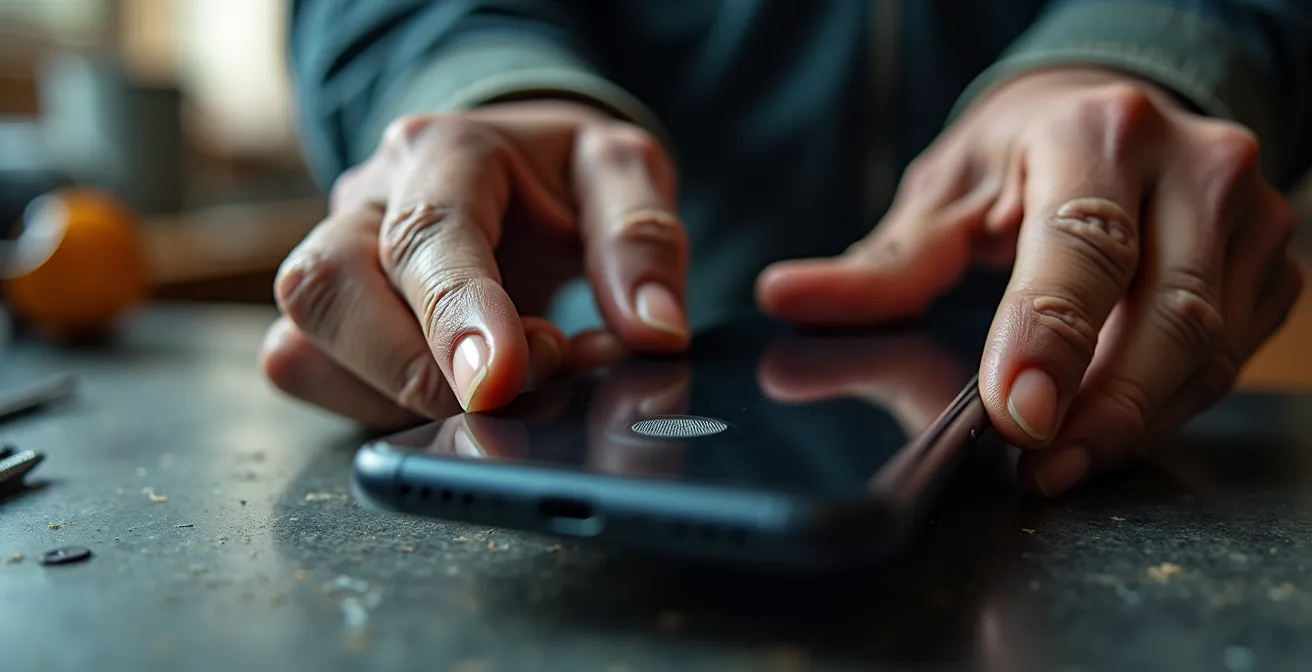
If your fingerprint scanner constantly fails due to dry, worn, or calloused hands, the problem isn’t just dirty sensors or faulty hardware. It’s a systematic calibration failure. This guide moves beyond simple tips, providing a researcher’s framework for deliberately training your phone’s biometric algorithm to reliably recognize your unique physiological signature, ensuring consistent access when you need it most.
That moment of frustration is universal: you place your thumb on your phone’s screen, and nothing happens. You try again. “No match found.” For many, especially those with dry skin from aging, frequent hand washing, or manual labor, this isn’t an occasional annoyance—it’s a daily barrier to using a device that’s central to modern life. The common advice to “moisturize your hands” or “clean the sensor” offers temporary relief at best and fails to address the root of the problem.
The issue runs deeper than surface-level contamination. It’s a fundamental disconnect between your unique skin characteristics and the rigid expectations of a digital sensor. From a usability research perspective, the problem isn’t a “bad” fingerprint; it’s an “untrained” algorithm. The scanner hasn’t been properly taught to recognize the specific patterns of your physiological signature, including its cracks, callouses, and dryness.
But what if, instead of fighting the technology, you could systematically teach it? This guide reframes the solution. We will treat your device not as a stubborn lock, but as a learning system that requires deliberate biometric calibration. We’ll explore the science behind why scanners fail, provide a professional protocol for training them, and examine robust alternatives like advanced Face Unlock configurations and hardware security keys. We will also delve into the critical security considerations that every biometric user must understand, from protecting your data at a border crossing to knowing when a simple notebook might be safer than a password manager.
This comprehensive overview will guide you through the intricacies of biometric security, empowering you to make informed decisions and finally achieve reliable access to your digital life. The following sections break down each component, from troubleshooting hardware to understanding the legal landscape.
Summary: A Researcher’s Guide to Biometric Reliability and Security
- Why Your Screen Protector Is Making Your Fingerprint Scanner Fail?
- How to Configure Face Unlock to Recognize You with Sunglasses or a Scarf?
- Face Unlock or 6-Digit PIN: Which Is Legally More Secure at a Border Crossing?
- The Cleaning Mistake That Permanently Damages Touch ID Sensors
- How to Rapidly Disable Biometrics in an Emergency Situation?
- YubiKey or SMS: Is Buying a Hardware Key Worth It for Personal Email?
- Why On-Device Processing Is the Only Way to Keep Your Chats Private?
- Password Manager vs. Notebook: Which Is Actually Safer for Banking Logins?
Why Your Screen Protector Is Making Your Fingerprint Scanner Fail?
While a screen protector is essential for protecting your display, it can be a primary source of failure for in-display fingerprint scanners. The protector adds a physical layer that can distort or obscure the very details the sensor needs to see. This problem is particularly pronounced for users with already-faint or worn fingerprints. To understand why, we must first distinguish between the two main types of in-display technology: optical and ultrasonic.
Optical sensors work like a tiny camera, taking a 2D photograph of your fingerprint. A screen protector, especially a thicker tempered glass one, can create microscopic air gaps or reflect the sensor’s light, blurring the resulting image. Ultrasonic sensors, conversely, use sound waves to create a detailed 3D map of your fingerprint’s ridges and valleys. While more accurate, they are also sensitive to materials that dampen these sound waves, which many screen protectors do.

This hardware challenge is compounded by physiological factors. Research confirms the difficulty, with one study finding that 27% of dermatitis patients fail fingerprint verification due to dry and altered skin. When you combine a faint physiological signature with a distorting screen protector, the recognition threshold is often not met. The solution is not necessarily to remove the protector, but to conduct a thorough biometric calibration to teach the algorithm to see through it.
Your Action Plan: The Professional Re-Calibration Protocol
- Increase Sensitivity First: Before enrolling new prints, go to your phone’s display settings and enable “Touch sensitivity” (or a similar feature). This boosts the screen’s responsiveness to compensate for the protector.
- Multi-Slot Registration: Register the same finger in 2-3 different fingerprint slots. This gives the algorithm more reference data for a single digit, dramatically increasing the chance of a match.
- Vary Pressure and Angle: During each of the multi-slot registrations, deliberately vary the pressure you apply and the angle of your finger. Scan the center, the tip, and the sides to create a comprehensive 3D model.
- Enroll a “Moisturized” Print: For one of your registration slots, apply a small amount of non-greasy hand lotion, let it absorb for a minute, and then enroll your finger. This teaches the algorithm what your “best-case scenario” print looks like.
- Periodic Re-Training: If you notice reliability decreasing over weeks or months (as your skin changes), delete the old prints and perform this re-calibration protocol again to update the system.
How to Configure Face Unlock to Recognize You with Sunglasses or a Scarf?
When fingerprint scanning remains unreliable despite calibration, Face Unlock becomes the most viable accessibility alternative. As noted by phone manufacturers like Google, it’s the primary recommendation for users with consistently compromised fingerprints due to work or skin conditions. However, just like fingerprint readers, Face Unlock can fail if your appearance deviates too much from the baseline data it was trained on. Wearing sunglasses, a hat, or a winter scarf can prevent it from recognizing you.
The principle for improving its accuracy is the same as with fingerprints: deliberate, strategic training. Modern facial recognition systems use machine learning that adapts over time. Every time it fails and you enter your PIN, you are providing it with new data. The system notes what you looked like during the failure and associates that appearance with a successful PIN entry, slowly expanding its recognition library. You can accelerate this learning process intentionally.
The goal is to gradually introduce accessories, allowing the algorithm to learn your facial structure even when parts of it are obscured. By systematically adding and combining items, you build a robust and flexible facial profile that works in a wider variety of real-world conditions.
Strategic Face Unlock Training Protocol:
- Phase 1: Establish a Clean Baseline: Start by deleting your existing face data and re-enrolling in a well-lit room with a clean face and no accessories. This creates a strong foundation.
- Phase 2: Add Sunglasses: Put on your most frequently worn sunglasses and unlock the phone successfully 5-10 times. If it fails, enter your PIN. This teaches the system to focus on the lower half of your face.
- Phase 3: Introduce Obscuring Items: Let the system fail to recognize you while wearing a hat or beanie. Then, immediately enter your PIN. Repeat this a few times to feed the algorithm learning data.
- Phase 4: Try Partial Coverage: Attempt to unlock with a scarf or mask partially covering your chin and mouth. Again, use the PIN after failures to reinforce the learning.
- Phase 5: Combine Accessories: Gradually start combining items, such as sunglasses and a hat. This final step expands the system’s recognition range to its maximum potential.
Face Unlock or 6-Digit PIN: Which Is Legally More Secure at a Border Crossing?
In most daily scenarios, Face Unlock is secure enough. However, at a border crossing, the definition of “secure” changes from protecting against thieves to protecting against compelled searches by government authorities. In this high-stakes context, a 6-digit PIN is unequivocally more secure from a legal standpoint. The distinction lies in the difference between something you *are* (your face) and something you *know* (your password).
In many jurisdictions, including the United States, legal precedent allows law enforcement to compel you to provide your biometrics—your face or fingerprint—to unlock a device. This can be done by simply holding the phone up to your face. However, they cannot legally compel you to reveal the contents of your mind, such as a PIN or password. This critical legal difference makes a knowledge-based unlock method the only way to ensure your data remains private during a search.

Government agencies take biometric collection seriously; for instance, CBP’s facial comparison technology is touted as having a high accuracy rate. This demonstrates the power of the systems you may encounter, reinforcing the need for personal data protection. Before traveling, especially internationally, it’s wise to prepare a “digital go-bag” to protect your information.
Digital Go-Bag Checklist for Border Crossings:
- Disable all biometric authentication (Face Unlock, Fingerprint) in your phone’s settings before you reach the airport or border.
- Power your device down completely. Most modern phones require a PIN or password on the first startup, bypassing biometrics entirely.
- Enable airplane mode. While not a foolproof protection at a checkpoint, it prevents remote connections and data syncing.
- If possible, consider using a separate “travel device” that contains only essential travel apps and no sensitive personal or work data.
- Research and understand your rights regarding electronic device searches for both your departure country and your destination.
The Cleaning Mistake That Permanently Damages Touch ID Sensors
The title of this section contains a common misconception. The cleaning mistake in question doesn’t permanently damage the electronic sensor itself, but it can cause significant, long-term damage to the one thing the sensor relies on: the delicate ridges of your fingerprint. For manual laborers and healthcare professionals, this is a critical issue. The culprit is the frequent use of harsh, alcohol-based hand sanitizers and industrial cleaning agents.
As one study on fingerprint degradation in healthcare workers highlights, alcohol or chlorhexidine-based sanitizers are extremely drying. According to experts cited in the study, “Even if they add moisturizers, the residual chemicals can still be challenging to overcome.” Over time, this constant chemical exposure can wear down the epidermal ridges, making fingerprints smoother, flatter, and far more difficult for any scanner—optical or ultrasonic—to read. This creates a state of “disappearing fingerprints,” a condition well-known among certain professions.
While you may need these chemicals for your job, you can mitigate the damage and preserve your biometric signature by adopting a safer cleaning protocol for your hands and your device. The focus is on gentle cleaning and aggressive moisturizing to counteract the drying effects of your work environment.
Safe Cleaning and Maintenance Protocol:
- For Hands: Whenever possible, use warm water and gentle soap instead of alcohol-based sanitizers. When drying, pat your hands lightly with a towel and let them air-dry the rest of the way. Immediately follow up with a quality, non-greasy moisturizing lotion, especially before attempting to use your phone.
- For the Sensor: Never use alcohol, ammonia, or any harsh chemical directly on the screen or sensor area. To clean heavy soil or grime, use a slightly damp microfiber cloth with a small amount of water only.
- Polishing: After cleaning with a damp cloth, immediately follow up with a separate, dry microfiber cloth to polish the surface and remove any moisture residue.
How to Rapidly Disable Biometrics in an Emergency Situation?
Knowing how to secure your device is one thing; being able to do it in seconds under duress is another. There are situations where you may need to instantly disable Face ID or fingerprint access to prevent compelled unlocking. As the Electronic Frontier Foundation (EFF) has pointed out, this is a fundamental digital security right.
Biometric authentication can be compelled by physical force, while knowledge-based authentication (PIN/password) cannot be extracted from one’s mind.
– Electronic Frontier Foundation, Digital Privacy at U.S. Borders Guide
Both iOS and Android have built-in “Lockdown” modes designed for this purpose. Activating it immediately disables all biometric sensors and requires your PIN or password for the next unlock. Learning the specific button combination for your device and practicing it until it becomes muscle memory is a critical security skill.
Emergency Biometric Lockdown Procedures:
- iOS Lockdown (iPhone): Press and hold the Side button and either Volume button simultaneously for about two seconds. The power-off screen will appear, and biometrics will be disabled automatically.
- Android Lockdown: This feature must typically be enabled first. Go to your Lock Screen settings and turn on the “Show lockdown option.” Once enabled, press and hold the power button to bring up the power menu, then tap “Lockdown.”
- The Universal Method (Reboot): If you forget the specific combination or need a more subtle action, simply reboot your phone. Holding the power button and selecting “Restart” will force a PIN/password entry upon startup on virtually all modern devices.
- Practice the Motion: Don’t wait for an emergency. Practice the button combination for your device several times until you can do it quickly without looking. The reboot method is often less suspicious in a tense situation.
YubiKey or SMS: Is Buying a Hardware Key Worth It for Personal Email?
For users who struggle with biometric reliability due to worn or dry fingerprints, the debate over two-factor authentication (2FA) takes on new importance. If you can’t rely on your finger, what is the next best option? While SMS-based 2FA is common, it has well-documented vulnerabilities. A dedicated hardware security key, like a YubiKey, offers a far more robust and, for many, more accessible solution.
Hardware keys are small physical devices that plug into a USB port or tap on your phone via NFC. They provide cryptographic proof that it is you trying to log in, and they are nearly immune to phishing and SIM swapping attacks that can defeat SMS codes. For those with manual labor jobs or skin conditions that make typing on a touchscreen difficult, the simplicity of a tap-to-authenticate NFC key is a significant usability win. It bypasses the need for both finicky fingerprints and typing in codes.
While there is an upfront cost, the investment in a hardware key is an investment in both superior security and reduced daily friction. The comparison below highlights the key differences.
| Feature | YubiKey (Hardware) | SMS 2FA |
|---|---|---|
| SIM Swapping Protection | Yes – Immune | No – Vulnerable |
| Phishing Resistance | Yes – Protocol-level | No – Can be intercepted |
| Working Hands Friendly | Yes (NFC tap) | Depends on touch typing |
| Single Point of Failure | Yes – Physical loss | Yes – Phone number |
| Cost | $45-70 one-time | Free (with phone plan) |
Why On-Device Processing Is the Only Way to Keep Your Chats Private?
The concept of privacy is often abstract, but in the world of digital security, it comes down to a simple question: who has access to the keys? When a service uses on-device processing, the answer is “only you.” This is the foundation of true end-to-end encryption and the only way to guarantee that your conversations, photos, and biometric data remain completely private.
On-device processing means that all sensitive computations—like recognizing your face, analyzing a photo for content, or encrypting a message—happen directly on your phone. The data is never sent to a company’s servers in a readable format. As privacy advocates explain, this means your data is essentially “meaningless junk” to the service provider, not just “‘promised’ to be private.” The encryption and decryption keys exist only on your device and the recipient’s device.
This stands in stark contrast to cloud-based processing. In that model, your data (like a photo) is uploaded to a server, analyzed by a powerful remote AI, and the results are sent back. While these connections are encrypted, the company technically has access to your unencrypted data on its servers, even if only for a moment. This distinction is critical, as seen in the different approaches of major tech companies. Apple’s Neural Engine, for example, is built to perform complex AI tasks like photo recognition locally, while some other services rely on uploading data for analysis. For anyone handling sensitive work communications or private family photos on their device, ensuring that the apps they use prioritize on-device processing is a non-negotiable privacy requirement.
Key Takeaways
- Fingerprint failure is often a calibration issue; train your sensor by registering the same finger in multiple slots with varied pressure.
- For absolute legal security (e.g., at borders), a PIN/password is stronger than biometrics, as a passcode cannot be legally compelled.
- Hardware security keys (like YubiKey) offer superior protection against phishing and are an excellent, accessible alternative for users with unreliable fingerprints.
Password Manager vs. Notebook: Which Is Actually Safer for Banking Logins?
The debate between a digital password manager and a physical notebook seems simple, but the correct answer depends entirely on your personal situation. As a usability researcher, I advise users to move beyond a simple “which is better” question and instead engage in personal threat modeling. You must first identify what you are trying to protect against. Are you more concerned about a remote hacker in another country or a nosy roommate with physical access to your home?
A password manager’s strength is its robust defense against remote, digital threats. It uses a strong master password and military-grade encryption to protect your vault. It can generate and store incredibly complex, unique passwords for every site, something no human can do. Its primary weakness, however, is that it’s a digital target. If your master password is weak or your device is compromised with malware, the entire vault is at risk. A physical notebook is the exact opposite. It is completely immune to online hacking. Its weakness is its vulnerability to physical threats: theft, loss, fire, or simple discovery.
To make the right choice, you must honestly assess your risks and environment. The framework below can guide your thinking.
| Security Layer | Password Manager | Physical Notebook |
|---|---|---|
| Primary Defense | Master password + encryption | Physical hiding location |
| Secondary Defense | 2FA on manager account | None |
| Tertiary Defense | Vault encryption | None |
| Password Complexity | Unlimited (auto-generated) | Limited by memory |
| Disaster Recovery | Cloud backup | Lost forever |
The first step in securing your digital life is to conduct this personal threat assessment. By understanding what you’re protecting and who you’re protecting it from, you can choose the tools and methods that offer you the most practical and effective security for your unique circumstances.