
That nagging feeling that you’re paying a monthly “connectivity tax” for features your car already has is justified. This isn’t just about heated seats; it’s a battle for control over your vehicle’s functions, data, and future value. This guide moves beyond listing fees to provide a strategic framework, revealing the hidden data supply chain and technological traps so you can reclaim digital sovereignty over the car you own.
The frustration is palpable. You’ve just spent a significant amount of money on a new vehicle, only to discover that core features—like the ability to start it from your kitchen on a cold morning or even enjoy peak horsepower—are held hostage behind a monthly paywall. This trend, a clear symptom of widespread subscription fatigue, has officially infiltrated the automotive world. For many car buyers, it feels less like an innovative service and more like being nickel-and-dimed for hardware they’ve already purchased.
The common advice is often to simply “say no” or opt for vehicles that rely on phone projection systems like Apple CarPlay and Android Auto. While sound on the surface, this perspective misses the deeper issue. Automakers are not just looking for a new revenue stream; they are fundamentally redefining car ownership. They are transforming vehicles from physical assets you own into connected platforms they control. This shift has profound implications for your privacy, the long-term usability of your car, and its resale value.
But what if the key wasn’t just to resist the subscription, but to understand the system well enough to disarm it? The true power lies not in simply avoiding a fee, but in knowing how your car’s data is being used, how its features can be disabled remotely, and what steps you must take to protect your digital sovereignty. This is about moving from an annoyed consumer to an empowered owner.
This article will dissect the mechanisms behind the connected car economy. We will explore how over-the-air updates can remove features, how your driving habits become a commodity, and why the battle for your dashboard’s operating system is so critical. By understanding these pillars, you can make an informed decision that goes far beyond the monthly cost.
To navigate this complex new landscape, this guide breaks down the essential areas you need to master. The following sections provide a clear roadmap to understanding the risks, protecting your privacy, and ultimately deciding if any connected service is truly worth the price of admission.
Summary: The Definitive Guide to Navigating Car Subscription Fees
- Why Your Car Might Lose Features After an Over-the-Air Update?
- Insurance Tracking: How to Check If Your Car Is Reporting Your Driving Habits?
- CarPlay/Android Auto or Native OS: Which Will Age Better Over 10 Years?
- The Connectivity Mistake That Could Disable Your Remote Start in Older Cars
- How to Perform a Factory Reset on Your Car to Protect Your Location History?
- Cellular vs. RFID: Which Tech Allows You to Recover Stolen Cargo Real-Time?
- How to Keep Your Home Number Active for Bank Texts While Using Data Abroad?
- How Global Asset Tracking Prevents Loss of High-Value Shipments?
Why Your Car Might Lose Features After an Over-the-Air Update?
The promise of over-the-air (OTA) updates is seductive: your car gets better over time, with new features and security patches delivered wirelessly while you sleep. However, this same technology gives manufacturers an unprecedented and often unseen power: the ability to remove or restrict features you thought you owned. This practice turns your car’s functionality into a mutable service rather than a permanent asset, a concept we can call “feature hostage.” You paid for the physical hardware, but the software that makes it work is rented.
This isn’t a theoretical risk. Automakers have already demonstrated their willingness to use OTA updates to alter a vehicle’s capabilities post-purchase. Famously, Tesla has removed Autopilot features from used cars, forcing new owners to repurchase software capabilities that the vehicle was physically equipped with and that the previous owner had paid for and enjoyed. This sets a dangerous precedent where the value and features of a car are not tied to the vehicle itself, but to an account that can be reset at the whim of the manufacturer.
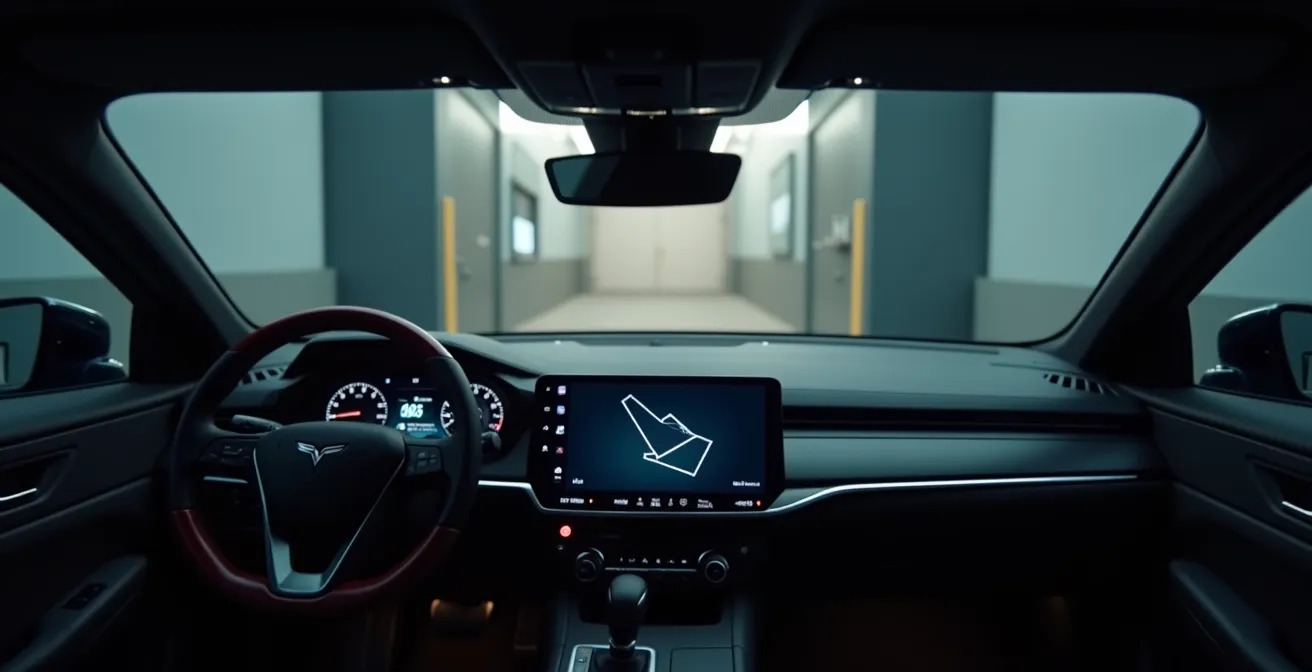
These “optimizations” or “adjustments” mentioned in update release notes can be a smokescreen for downgrading non-subscribed features or paving the way for future subscription models. A feature that is free today could be placed behind a paywall in the next update. As a car owner, you are no longer just a driver but a system administrator who must be vigilant about what changes are being pushed to your vehicle. Declining non-critical updates until you can verify their impact in owner forums is becoming a necessary defensive strategy.
Insurance Tracking: How to Check If Your Car Is Reporting Your Driving Habits?
Beyond holding features hostage, the connectivity in modern cars has created a hidden, lucrative market for your personal driving data. Many owners are unknowingly enrolled in “smart driving” programs that monitor their every move—hard braking, rapid acceleration, late-night driving, and speeds over 80 mph—and then sell this information to a shadowy data supply chain. This information is then used by insurance companies to set your rates, often without your explicit, informed consent. You may be a safe driver, but a few hard stops while navigating city traffic could be misinterpreted by an algorithm and end up costing you dearly.
A recent New York Times report exposed how General Motors, through its OnStar Smart Driver program, collected detailed driving behavior and sold it to data brokers like LexisNexis and Verisk. These brokers then packaged the data into “risk scores” for insurers. This practice is not a niche problem; the scale is massive. The telematics market is growing rapidly, with projections to reach 30 million policies in the US by 2027. Your car is no longer just a mode of transport; it’s a data collection terminal for the insurance industry.
To fight back, you must become proactive. Scour your car’s infotainment menus and its companion mobile app for any “gamified” driving features. They often have benign names like ‘Driving Score’ or ‘Driver Feedback’. Disable them immediately. Furthermore, you have the right to know what these data brokers know about you. You can and should request your personal data reports directly from LexisNexis and Verisk. This will not only reveal what information has been collected but is the first step in attempting to get it deleted and protecting your financial future from your own vehicle’s surveillance.
CarPlay/Android Auto or Native OS: Which Will Age Better Over 10 Years?
The central battleground for control in your vehicle is the infotainment screen. On one side, you have phone projection systems like Apple CarPlay and Android Auto, which leverage the powerful, constantly updated device in your pocket. On the other, you have the automaker’s native operating system (OS), which is increasingly tied to subscription services. The choice between them is not just about preference; it’s a 10-year commitment with significant financial and technological consequences.
Phone projection is, for now, largely free. It uses your phone’s data plan and processing power, ensuring your maps, music, and apps are always up-to-date. The interface evolves with your phone, not your car, preventing the clunky, outdated software problem that plagued older vehicles. In contrast, a native OS with embedded connectivity is a deliberate strategy by automakers to create an ongoing revenue stream—a “connectivity tax.” As one industry analysis from the TestMiles Automotive Report noted, “GM’s decision to remove Apple CarPlay/Android Auto and shift to its own native platform is telling. It suggests software/data control is becoming an automaker’s priority.”
The long-term financial difference is stark. While CarPlay is free, a native OS subscription for navigation, remote services, and entertainment can easily cost hundreds or even thousands of dollars over the lifespan of a vehicle. The true cost becomes painfully clear when laid out over a decade.
| System Type | Monthly Cost | 10-Year Total | Hardware Dependency |
|---|---|---|---|
| Native OS Subscription | $8-$50/month | $960-$6,000 | Built-in 4G/5G modem |
| CarPlay/Android Auto | $0 (uses phone data) | $0 additional | User’s smartphone |
| In-Car WiFi Hotspot | $15-$40/month | $1,800-$4,800 | Vehicle modem required |
Choosing a vehicle that fully supports phone projection is a powerful vote for an open ecosystem and a defense against the connectivity tax. It ensures your in-car tech ages as gracefully as your smartphone, not as quickly as the manufacturer’s interest in supporting older hardware fades.
The Connectivity Mistake That Could Disable Your Remote Start in Older Cars
The reliance on cellular connectivity for vehicle features introduces a critical vulnerability: forced obsolescence. Your car’s advanced features, from remote start to emergency SOS calls, are dependent on a cellular network that will inevitably be shut down. The most painful and recent example is the 3G network sunset, which turned thousands of perfectly functional vehicles into “dumber” versions of their former selves overnight. Owners who had paid for premium features found them suddenly and permanently disabled.
This was not a minor inconvenience. When the 3G network was decommissioned, owners of various Honda and Acura models lost access to HondaLink remote services, including remote start/stop, security alerts, and even stolen vehicle locator. Audi owners lost an even wider suite of ‘Audi connect’ services. The mistake was assuming that the connectivity a car was sold with would be supported for the life of the vehicle. In reality, automakers offloaded the cost and responsibility of this technological shift onto their customers.
For some, there was a path forward, but it was costly. According to Consumer Reports, some owners were faced with hardware upgrade costs that could be upward of $900 to maintain connectivity. This is the ultimate subscription trap: you’re forced to pay a large, lump sum not for a new feature, but just to keep the ones you already had. As we move from 4G to 5G and beyond, this cycle of forced obsolescence is guaranteed to repeat. A car’s dependency on a specific cellular generation is a hidden expiration date on its most advanced features.
How to Perform a Factory Reset on Your Car to Protect Your Location History?
When you sell a connected car, you’re not just handing over the keys; you’re potentially giving away years of personal data, including everywhere you’ve been. A common myth is that a simple factory reset from the infotainment menu is enough to wipe the slate clean. This is dangerously incomplete. A factory reset typically only deletes data stored locally in the car. It does nothing to erase the mountain of information—location history, driving habits, and more—that has already been synced to the manufacturer’s cloud servers.
Reclaiming your digital sovereignty before a sale requires a more thorough and strategic approach. You must meticulously scrub your digital footprint from the vehicle’s local memory, its connection to your personal accounts, and, most importantly, from the automaker’s servers. This involves unpairing all Bluetooth devices, logging out of every connected service like Spotify or Google, manually deleting saved destinations from the navigation, and removing the vehicle from your account on the manufacturer’s web portal or app.
The most critical step, however, is one most people miss: formally requesting data deletion from the automaker itself. Under privacy regulations like GDPR in Europe and CCPA in California, you have the right to have your personal data erased. This is the only way to ensure your history isn’t passed on to the next owner or retained by the company for years. Failing to complete this full process is like selling a smartphone without logging out of your Apple ID or Google account—it’s a massive privacy and security risk.
Your Pre-Sale Privacy Protection Checklist
- Perform a factory reset through the vehicle’s settings menu to wipe local storage.
- Manually unpair all Bluetooth devices from the infotainment system.
- Log out of all integrated personal accounts (e.g., Google, Apple, Spotify).
- Delete all saved destinations, home addresses, and location history from the navigation system.
- Remove the vehicle from your profile on the manufacturer’s online portal and smartphone app.
Cellular vs. RFID: Which Tech Allows You to Recover Stolen Cargo Real-Time?
While technologies like RFID are useful for tracking inventory at a checkpoint, only active cellular-based GPS provides the real-time location data necessary to recover a high-value, moving asset—like a stolen vehicle. Automakers understand this better than anyone, which is why they embed these powerful tracking systems into their cars. However, their primary motivation is no longer just vehicle recovery; it’s about tracking and monetizing their most valuable asset: you, the owner.
This embedded cellular modem is the key that unlocks a treasure trove of recurring revenue. It’s the backbone for every subscription service, from remote start to the data-sharing programs that monitor your driving for insurers. The cost of these OEM-provided services can be exorbitant, often reaching up to $800 a year for premium security and tracking packages. This is a far cry from the one-time cost of a hidden third-party GPS tracker or an Apple AirTag.
The end goal for automakers is to transform the car into a perpetual revenue platform. It’s a strategic pivot from a one-time sale to a decade-long financial relationship. The numbers they are targeting are staggering. According to an S&P Global Mobility analysis, GM is targeting $20 billion to $25 billion a year in software and subscriptions revenue by the end of the decade. This isn’t a side business; it’s the future of their business model. Your car’s location and status are tracked in real-time, not just for your safety, but for their bottom line.
How to Keep Your Home Number Active for Bank Texts While Using Data Abroad?
Managing the complexities of modern digital life, such as ensuring you can receive critical bank texts while traveling internationally, is a perfect analogy for the mounting burden of subscription fatigue. Your car’s new monthly fee doesn’t exist in a vacuum. It’s another log on a fire of recurring charges for video streaming, music, software, and more. This “subscription stacking” is leading to consumer burnout, and automakers are pouring gasoline on the fire by charging for features that were once included in the vehicle’s purchase price.
The practice is becoming increasingly bold. For example, on certain Toyota vehicles, the remote start feature—a function for which the hardware is already installed and paid for—now requires an $8 monthly subscription after a free trial period. This move blurs the line between a service and a ransom. You are being asked to pay repeatedly for a physical component you already own. This isn’t an isolated incident; it’s part of an industry-wide push to normalize paying for hardware features on a recurring basis.
This financial pressure is compounded by the sheer volume of other subscriptions consumers are already juggling. For context, U.S. consumers are already spending heavily on other services, creating a sensitive environment for new, arguably less essential, fees. The fight against car subscriptions is part of a larger consumer pushback against a world where ownership is being replaced by endless rental. Every new fee, no matter how small, adds to the weight and complexity of managing our financial and digital lives.
Key Takeaways
- OTA updates can remove features you paid for, turning your car’s hardware into a “feature hostage” controlled by the manufacturer.
- Your car is likely tracking your driving habits and selling the data to insurers via a hidden data supply chain, impacting your rates.
- A factory reset does not erase data from manufacturer servers; you must formally request data deletion to protect your privacy before selling your car.
How Global Asset Tracking Prevents Loss of High-Value Shipments?
In the modern auto industry, the concept of “global asset tracking” has taken on a new meaning. The high-value asset being tracked is no longer just cargo in a shipping container; it is your vehicle and, more importantly, you as a source of recurring revenue. Through embedded connectivity, automakers now view every car they sell not as a finished product, but as a platform to be monetized over its entire lifecycle, anywhere in the world. This is the philosophical endgame of the connected car.
This strategy was articulated perfectly by GM CEO Mary Barra, who stated, “If I buy my vehicle today and two years from now, there’s something that’s been invented that’s new, or a new service or a new feature, people are willing to pay for that.” This quote reveals the core belief driving the subscription model: ownership is temporary, and the opportunity to charge for new value is permanent.
If I buy my vehicle today and two years from now, there’s something that’s been invented that’s new, or a new service or a new feature, people are willing to pay for that.
– Mary Barra, GM CEO, Automotive News
This philosophy is already in practice. We are now seeing subscriptions for things that were once intrinsic to the car’s performance. In a move that crystallizes this new reality, Mercedes launched a horsepower subscription service in their electric vehicles. For an annual fee, owners can unlock faster acceleration—performance potential that was already engineered into the car. Your vehicle’s full capability becomes a feature you rent, not own. The car is an asset, and the manufacturer is simply leasing you its full potential, one year at a time.
The decision to pay for a connected car subscription is therefore not a simple transaction. It is an agreement to participate in this new model of ownership, where your car is a globally tracked asset in the manufacturer’s portfolio. Understanding this fundamental shift is the final key to deciding where you stand.
By understanding these tactics—from feature hostage to the data supply chain—you are now equipped to fight back. Your power as a consumer lies in your purchasing decisions and your willingness to demand transparency and control. Scrutinize the subscription models of any car you consider, prioritize vehicles that support open platforms like CarPlay, and be prepared to actively manage your data. This is how you shift from being a source of recurring revenue to being a true owner of your vehicle.
Frequently Asked Questions on Connected Car Data
Does a factory reset delete data already sent to the manufacturer?
No. A factory reset only wipes the car’s local storage but does not delete years of data that have already been synced to the manufacturer’s cloud servers. You must submit a formal deletion request.
What rights do I have to request data deletion?
Under regulations like the GDPR (General Data Protection Regulation) and CCPA (California Consumer Privacy Act), you have the legal right to request the complete deletion of your personal data from manufacturer servers.
How long does the manufacturer keep my driving data?
This varies by manufacturer, but policies often allow for data to be kept for 7-10 years unless a deletion is specifically and formally requested by the consumer.