Audio & Headphones
The modern headphone landscape has evolved far beyond simple audio playback. Whether you’re connecting wirelessly to your smartphone, blocking out office noise during deep work, or seeking studio-grade sound quality on the go, understanding the technology behind your headphones transforms them from mere accessories into precision tools. Yet many users struggle with frustrating latency during video calls, experience discomfort after extended wear, or fall victim to marketing claims that promise audiophile quality at budget prices.
This comprehensive resource addresses the core pillars of headphone technology that directly impact your daily experience. From the wireless protocols that determine if your audio stays synchronized with video, to the physics of noise cancellation and the health implications of prolonged use, to the legitimate markers of high-fidelity sound reproduction—each element plays a crucial role in finding the right audio solution for your needs. Understanding these fundamentals empowers you to make informed decisions and optimize the gear you already own.
How Wireless Connectivity Affects Your Listening Experience
Wireless freedom comes with technical trade-offs that aren’t immediately obvious when you first unbox your Bluetooth headphones. The convenience of cable-free listening depends on a complex chain of audio transmission technologies, each introducing potential points of delay or quality degradation.
Understanding Latency and Its Real-World Impact
Audio latency—the delay between when sound is produced and when you hear it—might seem negligible at 150-200 milliseconds, but this gap becomes painfully obvious during gaming or video streaming. Imagine watching someone speak on screen while their words arrive a fraction of a second late; your brain immediately registers this mismatch as unnatural. This phenomenon occurs because Bluetooth audio must be compressed, transmitted, received, and decoded before reaching your ears.
Gaming demands even stricter timing. When you fire a weapon or jump in a platformer, delays beyond 40 milliseconds create a disconnect between your actions and their audio feedback. This is why competitive gamers often choose wired connections or specialized low-latency wireless dongles operating on dedicated 2.4GHz frequencies rather than standard Bluetooth.
The Role of Codecs in Audio Synchronization
Codecs act as translators between your device and headphones, compressing audio data for wireless transmission. The codec your device uses dramatically affects both sound quality and latency. Standard SBC codec offers universal compatibility but introduces delays of 150-200ms. More advanced codecs like aptX Low Latency reduce this to approximately 40ms, while aptX Adaptive dynamically adjusts based on your activity.
However, here’s the crucial detail most marketing materials omit: both your source device and headphones must support the same advanced codec. If your smartphone only outputs SBC while your headphones advertise aptX support, you’ll default to the lowest common denominator. This codec negotiation happens automatically and invisibly, explaining why two users with “identical” headphones may experience different latency.
Managing Interference in Wireless Environments
Bluetooth operates in the crowded 2.4GHz frequency band, sharing space with WiFi routers, wireless mice, microwave ovens, and dozens of other devices in typical urban environments. When multiple Bluetooth devices compete for bandwidth—picture a busy coffee shop or open office—connection stability suffers. Audio may stutter, drop briefly, or require reconnection.
Modern Bluetooth versions address this through adaptive frequency hopping, rapidly switching between 79 different channels to avoid interference. Understanding that connection quality depends on environmental factors helps you troubleshoot issues: moving away from WiFi routers, reducing the number of simultaneously connected Bluetooth devices, or switching to wired connections in particularly crowded signal environments can immediately resolve frustrating dropouts.
Noise Isolation and Active Cancellation Technologies
Unwanted environmental noise doesn’t just annoy—it actively drains cognitive resources and can contribute to long-term hearing damage as you increase volume to compensate. Two distinct approaches address this challenge, each with unique benefits and physiological considerations.
Passive Isolation Versus Active Noise Cancellation
Passive isolation works like earplugs: physical barriers (ear pads, silicone tips) block sound waves from reaching your ear canal. This purely mechanical approach effectively attenuates high-frequency sounds—conversations, keyboard clicks, birdsong—without requiring power or processing. Well-designed passive isolation can reduce ambient noise by 15-30 decibels.
Active Noise Cancellation (ANC) takes a fundamentally different approach by generating sound. External microphones capture ambient noise, onboard processors analyze these sound waves, and speakers produce inverse waves that cancel the original noise through destructive interference. ANC excels at eliminating consistent low-frequency rumble: airplane cabin drone, air conditioning hum, or traffic noise. The technology struggles with irregular, high-pitched sounds like voices or sudden noises.
The Physiological Effects of Noise Cancellation
Constant exposure to low-frequency noise—even at moderate volumes—creates measurable cognitive fatigue. Your brain continuously processes these persistent sound patterns, diverting mental resources from focused work. This explains why an eight-hour day in an open office feels more exhausting than equivalent time in a quiet environment, even when both involve similar tasks.
Some users experience a sensation of pressure or fullness when activating high-performance ANC, often described as “cabin pressure” sensation. This occurs because your brain interprets the sudden absence of expected low-frequency environmental noise as a change in air pressure, similar to ascending in an airplane. While purely psychological and harmless, this sensation can be disorienting initially. Starting with moderate ANC levels and gradually increasing intensity allows your sensory system to adapt.
Optimizing ANC for Productivity and Maintenance
ANC effectiveness extends beyond music listening. Many productivity-focused users activate noise cancellation without playing audio, creating a quiet environment for deep work sessions while maintaining awareness of important sounds through transparency modes. This approach proves particularly valuable in environments where music might distract from concentration-intensive tasks like writing or coding.
The physical components enabling noise cancellation require regular maintenance. Ear pad deterioration creates gaps that compromise both passive isolation and ANC performance, as microphones must work harder to compensate for leaked environmental noise. Replacing ear pads annually—or when you notice reduced softness or visible cracking—preserves the acoustic seal necessary for optimal noise cancellation.
Comfort, Fit, and Long-Term Health Considerations
Headphones make direct contact with your body for extended periods, creating unique comfort and hygiene challenges that significantly impact both user experience and health outcomes. Proper fit extends beyond avoiding discomfort—it fundamentally affects sound quality, noise isolation, and long-term ear health.
Finding the Right Form Factor for Your Needs
The over-ear versus in-ear decision involves trade-offs beyond portability. Over-ear headphones distribute pressure across your entire outer ear rather than the sensitive ear canal, typically allowing for longer comfortable wear sessions. However, they add heat buildup and can conflict with glasses, creating pressure points where arms press against the side of your head.
In-ear models solve the glasses compatibility issue but introduce different considerations. Silicone tips create a tight seal necessary for bass response and noise isolation, yet this seal blocks natural ear canal ventilation. Foam tips offer superior comfort and isolation through compression but reduce air circulation even further, raising moisture and bacterial concerns during extended use or physical activity.
Material Choices and Skin Breathability
Ear tip material selection significantly impacts skin health during prolonged contact. Silicone tips offer easy cleaning and durability but create a non-porous seal that traps moisture and heat. For sessions under two hours in climate-controlled environments, this presents minimal concern. However, users wearing earbuds throughout entire workdays may experience irritation from accumulated moisture.
Foam tips conform to your unique ear canal shape, providing superior passive isolation and often more comfortable pressure distribution. Yet this same porous structure absorbs sweat, oils, and earwax, creating environments where bacteria thrive. Foam tips require replacement every 1-3 months depending on use frequency, whereas silicone tips can last indefinitely with proper cleaning.
Hygiene Protocols and Common Usage Mistakes
Regular cleaning prevents bacterial buildup that causes ear infections and premature material degradation. For silicone components, weekly cleaning with 70% isopropyl alcohol on a cotton swab effectively removes oils and kills bacteria without damaging materials. Allow complete drying before reinsertion—this typically takes 10-15 minutes at room temperature.
One critical mistake undermines both hygiene and device longevity: wearing earbuds immediately after exercise while your ears remain wet with perspiration. Moisture trapped inside the ear canal by earbuds creates an ideal bacterial breeding environment and can damage driver components through liquid ingress. Always dry your ears thoroughly and allow a cooling period before inserting earbuds post-workout. Similarly, choosing proper fit is essential for active use—earbuds that shift or fall out during movement often indicate incorrect tip size rather than fundamental design incompatibility.
Understanding High-Fidelity Audio and Sound Quality
Audio quality marketing bombards consumers with impressive specifications and format names, yet many of these claims offer minimal perceptible benefit in real-world mobile listening scenarios. Distinguishing legitimate quality improvements from marketing theater requires understanding the entire audio reproduction chain.
The Bottlenecks in Mobile Audio Playback
High-resolution audio files preserve more musical detail than compressed formats, but Bluetooth transmission creates an immediate quality ceiling regardless of source file quality. Even advanced codecs like LDAC—while impressive compared to SBC—compress audio significantly compared to wired connections. Streaming a lossless FLAC file over Bluetooth forces recompression to fit wireless bandwidth limitations, negating much of the format’s advantage.
This explains why controlled listening tests consistently show that trained listeners struggle to reliably distinguish between high-bitrate MP3 (320kbps) and lossless formats during blind testing on consumer equipment. The difference exists in technical measurements, but typical headphone drivers, amplification, and environmental noise mask these subtle distinctions for most users in most contexts.
When Premium Components Make Audible Differences
The “Hi-Res Audio” certification sticker has become ubiquitous on products spanning the price spectrum, yet achieving the resolution these formats offer requires specific hardware capabilities. DAC (Digital-to-Analog Converter) and amplifier quality matters significantly more than file formats for mobile listening. Smartphone built-in audio processing varies wildly—some flagship devices include dedicated audio chips approaching standalone DAC performance, while others prioritize size and battery life over audio fidelity.
External DAC/amplifier combinations bypass your phone’s internal audio processing, providing cleaner power and better signal-to-noise ratios to drive demanding headphones. However, these benefits become apparent primarily with high-impedance headphones designed for dedicated amplification. Pairing a $300 portable DAC/amp with $50 earbuds yields minimal improvement—the headphone drivers themselves become the limiting factor.
Optimizing Source Settings for Your Platform
Both Android and iOS offer audio settings that significantly impact output quality, yet these remain hidden in developer menus or require third-party apps to access. Android’s developer options allow manual codec selection, enabling you to prioritize quality over battery life by forcing LDAC or aptX HD when available. iOS handles codec negotiation automatically but offers fewer manual override options.
Understanding that audiophile quality depends on the entire reproduction chain—from source file through transmission protocol through amplification to driver capabilities—protects you from marketing claims that emphasize one link while ignoring others. The most balanced approach prioritizes matching component quality: pairing premium headphones with quality amplification and high-bitrate sources, while recognizing that wireless convenience involves acceptable quality trade-offs for most mobile use cases.
The intersection of wireless technology, health considerations, comfort engineering, and audio fidelity creates a complex decision landscape for modern headphone users. Each pillar contributes essential knowledge: understanding latency helps you choose appropriate connectivity for your use case, recognizing how noise cancellation affects cognition and physiology enables healthier usage patterns, proper fit and hygiene prevent discomfort and health issues, and realistic expectations about audio quality prevent overspending on specifications that won’t benefit your actual listening environment. Mastering these fundamentals transforms headphones from simple purchases into optimized tools that enhance your daily audio experience.
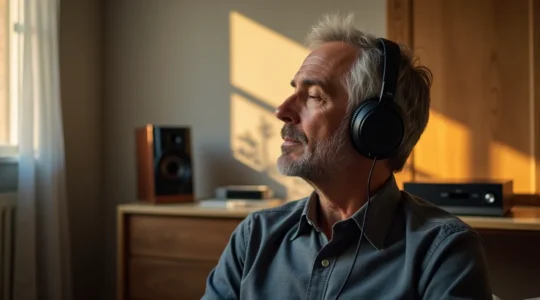
Is High-Resolution Audio Worth the Investment for Listeners Over 40?
The pursuit of “better” audio quality has convinced many that a high-resolution streaming subscription is the ultimate upgrade, but for most listeners over 40, this is a costly mistake. Your existing Bluetooth headphones are the biggest quality bottleneck, making lossless…
Read more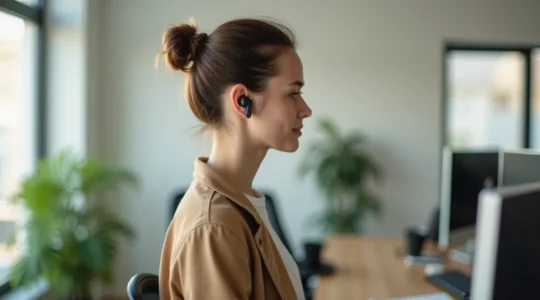
How to Prevent Ear Infections When Wearing Earbuds for 4+ Hours a Day?
The key to preventing earbud-induced infections isn’t just cleaning, but actively managing your ear canal’s delicate micro-environment. Trapped moisture and excessive pressure from a poor fit are the primary culprits, creating an ideal breeding ground for bacteria. Material choice (like…
Read more
How to Use ANC Headphones to Reduce Cognitive Load in Open Offices
The key to surviving an open office isn’t just blocking noise; it’s actively managing your cognitive load by creating a precisely controlled ‘auditory environment’. Active Noise Cancellation (ANC) excels at nullifying the low-frequency hum of HVAC systems, but passive isolation…
Read more
Why Your Bluetooth Audio Lags While Gaming and How to Fix It
Bluetooth audio lag isn’t a single flaw but a cumulative delay across the entire signal chain, known as the “latency stack.” Fixing it requires moving beyond simple tricks and understanding each bottleneck—from your phone’s audio codec and processing overhead to…
Read more